
WeChat:
+86 13871525936
Views: 399 Author: Anna Publish Time: 2024-09-25 Origin: Site
In data centers and high-performance computing environments, the speed, stability, and cost-effectiveness of data transmission are crucial. With the continuous advancement of technology, AOC (Active Optical Cable) and DAC (Direct Attach Cable) have emerged as two major high-speed connection solutions that are widely used.
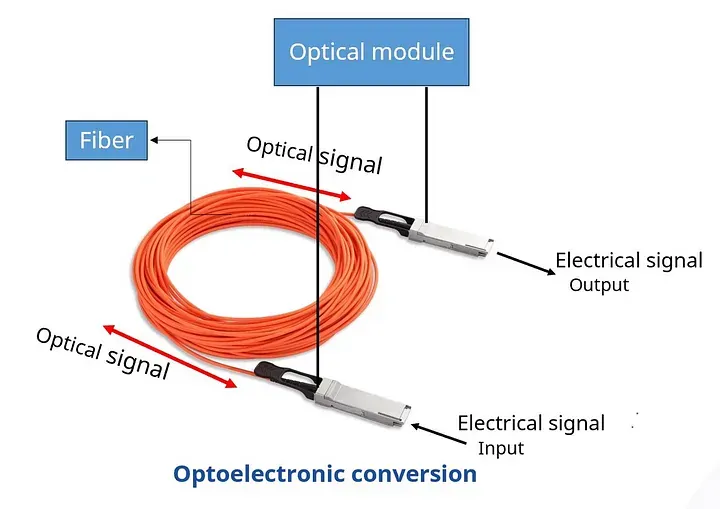

AOC cables contain active electronic devices such as lasers, photodetectors, and drive circuits. These devices are responsible for converting electrical signals into optical signals and converting optical signals back to electrical signals at the other end. This design enables AOC to achieve long-distance, high-bandwidth, and low-latency signal transmission.
1. Long-distance transmission: The transmission distance of AOC cables far exceeds that of copper cables of the same type, and can usually cover distances of 100 meters or more, making it an ideal choice for cross-data center or long-distance connections.
2. High bandwidth: AOC supports high-speed data transmission, such as 10Gbps, 40Gbps, 100Gbps or even higher rates, meeting the extremely high bandwidth requirements of modern data centers.
3. Low latency: Due to the fast transmission speed of optical signals, AOC has relatively low latency, which is suitable for application scenarios that are sensitive to latency requirements.
4. Low power consumption: Despite the internal electronic devices, AOC's power consumption is generally lower than that of copper cable solutions with equivalent performance, especially when transmitting over long distances.
AOC is particularly suitable for scenarios that require long-distance transmission, low latency, and high bandwidth, such as interconnection between servers within a data center, connection between servers and storage systems, and remote connections across data centers.
DAC cable is a passive cable composed of copper wires inside, which directly transmits electrical signals. Since there are no built-in electronic devices, the structure of DAC is relatively simple and the cost is low.
1. Short-distance transmission: The transmission distance of DAC cable is short, usually between a few meters and more than ten meters, which is particularly suitable for connections within a rack or between adjacent racks.
2. High bandwidth: In a short distance, DAC can support high-bandwidth transmission comparable to AOC, such as 10Gbps, 40Gbps, 100Gbps, etc.
3. Low cost: Due to its simple structure, the price of DAC cable is usually lower than that of AOC cable with the same performance, which is an economical choice for short-distance connection.
4. Low latency: DAC cable is directly connected to the port of the device without the need for an intermediate conversion process, so it has very low transmission latency.
DAC cables are widely used inside data centers, especially for interconnection between servers, switches and storage devices in the same rack or adjacent racks. In addition, DAC is also commonly used in top-of-rack (ToR) network architectures to provide short-distance high-speed links.
Comparison of DAC and AOC cables:
| Type | AOC Cable | DAC Cable |
Technical principle | Use active electronics to convert electrical signals into optical signals and back into electrical signals | Directly transmit electrical signals using copper wires |
Transmission distance | Long distance (100 meters or more) | Short distance (several meters to more than ten meters) |
Bandwidth | High (supports 10Gbps to 100Gbps and higher) | High (supports rates comparable to AOC) |
Delay | Low | Low |
Power consumption | Relatively low (especially over long distances) | Lower |
Application Scenario | Long distance, high bandwidth, and low latency requirements | Short-distance, high-density data center Andhigh-performance computing environments |
AOC (Active Optical Cable) and DAC (Direct Attach Cable) cables play an important role in the use of data centers, and they each have unique advantages and application scenarios. The following details the specific use of AOC and DAC cables in data centers:
Long-distance connections:AOC cables are particularly suitable for long-distance connections between different areas or racks within a data center due to their long-distance transmission capabilities (usually up to 100 meters or more). For example, in large data centers, AOC is an ideal choice for remote connections between servers and remote switches, storage devices, or across data centers.
High bandwidth and low latency requirements:For application scenarios that require high bandwidth and low latency, such as high-performance computing (HPC), cloud computing, big data processing, etc., AOC cables can provide stable and efficient data transmission. These applications have extremely high requirements for data transmission speed and data integrity, and AOC cables can meet these requirements.
Electromagnetic Interference (EMI) Immunity:Since AOC cables use optical fiber to transmit signals, and optical fiber as a dielectric cannot conduct current, AOC cables are naturally immune to electromagnetic interference. This makes AOC cables more reliable in data centers with complex electromagnetic environments.
Short-distance connections:DAC cables are mainly used for short-distance connections within data centers, such as interconnections between servers, switches, and storage devices within a rack or between adjacent racks. Due to its short transmission distance (usually between a few meters and more than ten meters), DAC cables can provide low-latency, high-bandwidth transmission performance.
Cost-effectiveness:Compared with AOC cables, DAC cables are less expensive. Due to its simple structure and no built-in electronic devices, the manufacturing cost and maintenance cost are relatively low. This makes DAC cables an economical choice for short-distance connections within data centers.
High-density deployment:In high-density deployment scenarios in data centers, such as server cabinets using top-of-rack (ToR) network architectures, DAC cables can provide compact and efficient connection solutions. The server can be directly connected to the switch on the top of the cabinet via a DAC cable, which simplifies wiring and reduces the workload of cable management.
AOC and DAC cables have their own advantages in the use of data centers. AOC cables are suitable for application scenarios with long distance, high bandwidth and low latency requirements; while DAC cables occupy an important position in short-distance connections within data centers due to their low cost and short-distance efficient transmission advantages. In actual applications, data centers can choose the appropriate cable type according to specific needs and scenarios to build an efficient, reliable and cost-effective network architecture.
When buying AOC (Active Optical Cable) and DAC (Direct Attach Cable) cables, you need to consider the following aspects to ensure that the selected cables can meet the specific needs of the data center or network architecture:
AOC cable: suitable for long-distance connections, usually up to 100 meters or longer. If long-distance data transmission is required between different areas or different racks within the data center, AOC is a better choice.
DAC cable: mainly used for short-distance connections, usually between a few meters and more than ten meters. Suitable for equipment interconnection within a rack or between adjacent racks.
Both support high-speed data transmission, such as 10Gbps, 40Gbps, 100Gbps, etc. However, the specific choice should be based on the actual bandwidth requirements. For application scenarios that require higher bandwidth, such as high-performance computing, cloud computing, etc., cables that can support the required bandwidth should be selected.
AOC cable: Despite the inclusion of electronic devices, AOC generally consumes less power than copper cable solutions of equivalent performance, especially when transmitting over long distances. This is particularly important for data centers that pursue low power consumption and energy saving.
DAC cable: The power consumption is relatively low, but may be slightly higher than AOC when transmitting over long distances.
AOC cable: Since optical fiber is used to transmit signals, it has natural immunity to electromagnetic interference. This is particularly important in data centers with complex electromagnetic environments.
DAC cable: Copper wires are used to transmit electrical signals, which may be more susceptible to electromagnetic interference. However, the impact is generally smaller over short distances and in controlled electromagnetic environments.
DAC cable: Due to its simple structure and lack of built-in electronic devices, DAC cable is generally less expensive than AOC cable. For application scenarios with limited budgets and low transmission distance requirements, DAC is a more economical choice.
AOC cable: The cost is relatively high, but it can provide long-distance, high-bandwidth and low-latency transmission performance.
AOC cable: installation and maintenance are relatively simple, but due to the electronic devices contained inside, more professional maintenance skills may be required.
DAC cable: easy to install and maintain, suitable for environments that require frequent replacement or maintenance.
When purchasing, you need to ensure that the selected cable is compatible with existing network equipment (such as switches, servers, etc.). This includes matching in terms of interface type, transmission rate, etc.
Choose well-known brands and high-quality products to ensure the stability and reliability of the cable. This is essential to ensure the normal operation of the data center and reduce the failure rate.
AOC Type | Description | Price |
10G | 10G SFP+ AOC Cable 1m 2m 3m 5m 7m 10m Active Optical Cable Module SFP+ to SFP+ 10G AOC Cable | US$16.00 - US$25.00 |
25G | 25G SFP28 AOC 1m 2m 3m 4m 5m 7m 10m Active Optical Cable Multimode SFP28 25G AOC | US$32.00 - US$41.00 |
40G | AOC Cable 40g QSFP to QSFP AOC Transceiver Module Active Optical Cable 1m 2m 3m 4m 5m 7m 10m | US$52.00 - US$71.00 |
100G | 100G QSFP28 to QSFP 28 AOC 1m 2m 3m 4m 5m 7m 10m | US$91.00 - US$110.00 |
200G | 200G QSFP56 to QSFP 56 AOC 1m 2m 3m 5m 7m 10m 20m Active Optical Cable | US$562.00 - US$600.00 |
400G | 10G 25G 40G 100G 200G 400G SFP+ SFP28 QSFP+ QSFP28 QSFP56 QSFP-DD 1m 2m 3m 5m 10m 20m 50m OM2 OM3 OM4 AOC Active Optical Cables | US$10.00 - US$800.00 |
DAC Type | Description | Price |
10G | 10G DAC SFP+ to SFP+ 1m 2m 3m 5m 7m 10m Passive Direct Attach Cable Copper Twinax 10Gbps Arista Compatible SFP 10G DAC Cable | US$7.00 - US$20.00 |
25G | DAC Cable 25G SFP28 DAC 1m 2m 3m 4m 5m Passive Direct Attach Copper Twinax Cable | US$14.00 - US$30.00 |
40G | 40G QSFP DAC Cable QSFP+ DAC 1m 2m 3m 4m 5m 7m Passive Direct Attach Cable | US$16.00 - US$48.00 |
100G | 100G QSFP28 DAC 1m 2m 3m 4m 5m Passive Direct Attach Copper Twinax Cable QSFP28 to QSFP28 Compatible Switch 100G DAC Cable | US$32.00 - US$74.00 |
200G | QSFP56 to 2x100G 200G QSFP56 DAC 1m 2m 3m PAM4 Passive Direct Attach Copper Breakout Cable | US$40.00 - US$70.00 |
400G | DAC Cable 400G QSFP-DD to 4x100G QSFP28 1m 2m 3m QSFP+ to QSFP+ | US$80.00 - US$160.00 |
AOC cables and DAC cables have their own advantages and disadvantages, and the choice of which cable to use depends on the specific network requirements. AOC cables, with their long distance, high bandwidth, and low latency, excel in scenarios that require long-distance connections and high-performance transmission. DAC cables, on the other hand, are the first choice for short-distance connections within data centers due to their low cost and short-distance, efficient transmission advantages. Understanding these differences and making wise choices based on actual needs will help build an efficient, reliable, and cost-effective data center network.


