
WeChat:
+86 13871525936
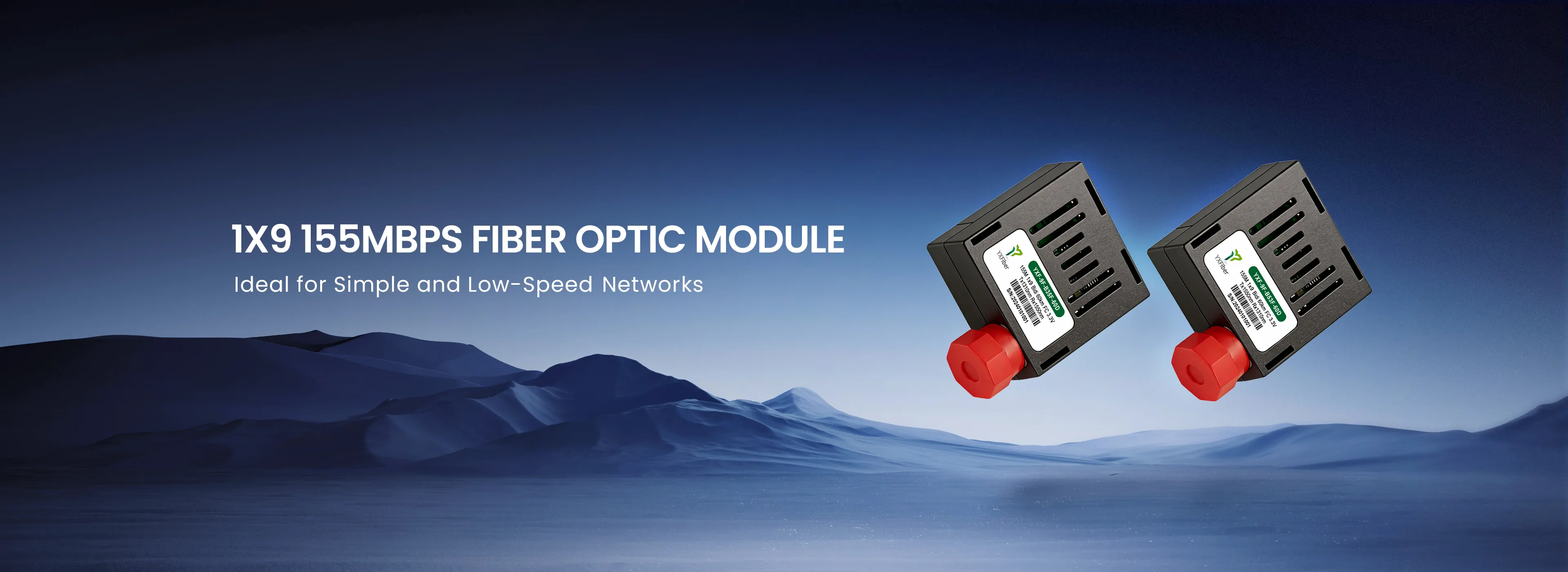
Currently, BiDi (Bidirectional) single-fiber optical modules are commonly used in ISP networks, FTTx deployments, and data centers operating at 1/10 Gbps transmission rates. These modules can be installed in devices such as switches, fiber media converters, and OEO converters to ensure stable optical transmission.
The core of the 10G SFP+ RJ45 copper module is the PHY chip and DSP (Digital Signal Processor). It integrates a signal processor that modulates electrical signals and cancels transmission interference. The YXFiber 10G SFP+ RJ45 copper module (YXF-PP-T-30) is designed based on the above architecture, delivering stable 10G transmission over 30 meters with typical power consumption of approximately 2.5W, bringing 10G high-speed connectivity to existing copper cabling infrastructure.
Now that we've covered each one, YXFiber will walk you through the key differences. In terms of data rate: SFP is generally for modules under 3G; SFP+ is for modules running 6G to 16G; SFP28 is for 25G/32G modules; QSFP+ is for 40G/56G modules; and QSFP28 is for 100G modules. In terms of built-in components: SFP, SFP+, and SFP28 use a single laser and a single detector, while QSFP+ and QSFP28 use 4-channel laser and detector arrays. Also, the interface protocols differ across all five form factors.
YXFiber was founded in 2015 and is headquartered in Optics Valley, Wuhan, China. At the beginning of its establishment, it focused on R&D, production and sales of optical fiber modes. Its main products include SFP, SFP+, QSFP, 1X9 and other series of optical transceivers, DAC AOC cables and media converters. YXFiber's continuous technological innovation and achievement transformation in the field of optical communications has been recognized as a high-tech enterprise in Wuhan.
Most modern switches with SFP+ ports can accept 1.25G SFP modules and auto-negotiate down to 1G. However, a 10G SFP+ module will not work in an SFP-only port. Furthermore, fiber optic modules—unlike copper RJ45 transceivers—do not support 10/100/1000 auto-negotiation; the vast majority run only at their rated speed. Even when an SFP+ port accepts a 1G module, three issues arise: the port's performance is severely capped, end-to-end latency increases by 15-20%, and network monitoring systems require extra configuration to correctly identify the actual speed.
The BIDI solution cuts fiber consumption by half, eliminating the need for additional cable laying or duct expansion. It is especially suitable for upgrading legacy campuses and residential FTTH networks where fiber resources are already saturated. YXFiber's gigabit single-fiber modules are sold as pre-paired units, reducing cabling, material, and labor costs by nearly 50% compared to dual-fiber configurations. With highly competitive unit pricing, these modules meet budget constraints for mid-to-small-scale projects.
The SR module operates at the 850nm band, a shorter wavelength that experiences less signal attenuation over multimode fiber. The LR module operates at the 1310nm band, a longer wavelength that enables lower loss and longer transmission distances over single mode fiber. The wavelength difference determines the fiber type and application scenarios they support — they are not interchangeable.
Optical modules store vendor information in firmware. Switches “check credentials” when modules are inserted – if they don‘t match, the module won’t be recognized. YXFiber products are verified with major brands – plug and play, no worries.
Market supply and demand constitute another critical factor influencing prices. Fluctuations in market demand alter the supply-demand balance; when supply exceeds demand, prices drop, whereas insufficient supply drives prices up. Given the constantly changing market landscape, prices inevitably fluctuate in response to shifts in supply and demand. To navigate this dynamic environment, YXFiber adopts a flexible supply strategy based on on-demand production and scalable capacity. We maintain deep information-sharing mechanisms with major global data centers and telecommunications equipment vendors, enabling us to anticipate demand changes in advance and precisely schedule our optical module production.
We have our own dust-free workshops and follow strict production procedures. Every single module goes through 15 manufacturing steps – from MATERIAL QUALITY TEST, CLIPPING PINS, WELDING, BURN-IN, SHAPING, SPECTRUM ANALYSIS, EYE DIAGRAM, TEMPERATURE TEST, FLOW METER TEST, TAGGING, CODING, COMPATIBILITY TEST, FACE INSPECTION, CLEANING, to PACKAGE – before it‘s approved for shipment. Not a single module leaves our facility without meeting our standards.
In short-distance scenarios, the unit price of 10G dual-fiber multi-mode modules is lower than that of 1G single-fiber modules at the same distance, but in long-distance scenarios, the unit price difference between the two is not significant. Moreover, the 1G single-fiber module has an integrated WDM coupler inside, and the process is more complicated. Its unit price is usually higher than that of a dual-fiber module with the same speed and distance. The more critical dimension is optical fiber. 1G single fiber only uses one optical fiber, while 10G dual fiber requires two optical fibers. When evaluating a module, you cannot just look at the module price. Optical fiber resources need to be taken into consideration in the cost dispute.
The difference between them is the speed difference. The broadband of 1.25G SFP is 1.25Gbps, which is usually used for Gigabit-level Ethernet transmission. The bandwidth of 100G QSFP28 is 100Gbps, playing the role of a massive data highway.
SFP (Small Form Factor Pluggable) is a compact, hot-swappable transceiver module that converts electrical signals into optical signals (and vice versa), enabling long-distance communication between devices. One of the main advantages of SFP modules is their hot-swappable nature, which allows them to be inserted or removed without powering down network devices.
An optical transceiver is an optoelectronic device that uses optical signals to achieve high-speed data transmission. It provides stable, high-speed, and long-distance data interaction capabilities for communication equipment through the mutual conversion of electrical and optical signals, combined with optical fiber transmission media. Structurally, an optical transceiver mainly consists of an optical transmitting device (TOSA, including a laser), an optical receiving device (ROSA, including a photodetector), functional circuits, and optical (electrical) interfaces.
Driven by the rapid development of AI training clusters, hyperscale cloud data centers, and 5G core networks, 400G Ethernet interfaces have become the standard for next-generation networks. When selecting modules, the choice between form factors (QSFP-DD vs. OSFP) and optical interface types (such as SR4, DR4, or FR4) significantly impacts network performance, power consumption, cost, and future scalability. This article outlines the selection logic for 400G optical modules based on application scenarios and provides specific deployment recommendations.
With the growth of AI clusters and cloud computing, 400G optical modules have become the preferred choice for data centers. Among the various models and form factors available, the QSFP-DD DR4 stands out as an ideal solution for 400G data center deployments due to its low cost, high density, and ease of maintenance. YXFiber’s YXF-QDD-400G-DR4 fully meets the diverse requirements of data center applications. This article explores two typical connectivity scenarios for this module within actual data center networks.
Optical modules undergo rigorous testing and quality inspection procedures before shipment, including incoming material inspection, parameter testing, aging testing, actual device testing, and end-face inspection. All test results must meet standard levels; otherwise, the optical module will be returned to the production line for readjustment. Understanding these tests helps in identifying the quality of optical modules.
With the commercialization of AI, data centers have become the darling of the new era. The computing power of data centers is an important bargaining chip for major manufacturers to occupy the right to speak in the AI era. At the physical layer of the data center, as the core transmission carrier of data traffic, optical modules, which were once just standard accessories for network equipment, are being pushed to the forefront of the computing power competition by AI. From the rate evolution from 400G to 1.6T, and then to the technological leap from traditional pluggable to CPO, the impact of AI on optical modules is getting wider and deeper. This article will analyze in detail the impact of the AI era on the demand for optical modules.
With the expansion of data centres and with the advent of the AI era, the demand of data transmission is growing unabated. As one kind of network communication technology with stable performance, the 10 Gigabit copper interface has been a valuable choice for data transmission:
A BIDI optical module is a single-fiber bidirectional optical module, or BiDi (Bidirectional). Conventional modules are dual-fiber modules (connected by two optical fibers), with two fiber ports at the interface: a transmit port (TX) and a receive port (RX). BIDI modules, however, are single-fiber modules with only one fiber port. Different optical signals are transmitted and received within a single fiber; therefore, BIDI optical modules must be used in pairs. Visually, a BIDI module has only one port and uses only one optical fiber for connection.


