
WeChat:
+86 13871525936
Views: 399 Author: Anna Publish Time: 2025-10-13 Origin: Site
3. What is the difference between single-mode and multimode fiber?
3.1 Core Diameter
3.2 Light Source
3.3 Bandwidth
3.4 Jacket Color
3.5 Modal Dispersion
3.6 Price
Generally speaking, there are two types of optical fiber: Fiber that supports multiple propagation paths or transverse modes is called multimode fiber (MMF), while fiber that supports a single mode is called single-mode fiber (SMF).
In optical fiber communications, single-mode fiber (SMF) is a type of fiber that transmits light signals directly in a transverse mode. Single-mode fiber operates at data rates of 100 Mbps or 1 Gbps, and can transmit over distances of at least 5 kilometers. Typically, single-mode fiber is used for long-distance signal transmission.
Multimode fiber (MMF) is primarily used for short-distance optical fiber communications, such as within buildings or on campuses. Typical transmission speeds are 100 Mbps and distances up to 2 km (100BASE-FX), 1 Gbps up to 1000 meters, and 10 Gbps up to 550 meters. There are two types of refractive index: graded-index and step-index.
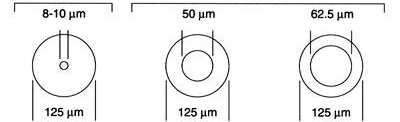
The primary difference between multimode and single-mode fiber is that multimode fiber has a larger core diameter, typically 50 or 62.5µm, while single-mode fiber typically has a core diameter of 8 or 10µm. Both types have a cladding diameter of 125µm.
Lasers and LEDs are commonly used as light sources. Laser sources are significantly more expensive than LEDs because they produce light that can be precisely controlled and has high power. LED sources, on the other hand, produce more dispersed light (many modes of light) and are therefore often used in multimode fiber patch cables. Meanwhile, laser sources (which produce light in a near-single mode) are commonly used in single-mode fiber patch cables.
Because multimode fiber has a larger core size than single-mode fiber, it supports multiple transmission modes. Furthermore, like multimode fiber, single-mode fiber exhibits modal dispersion caused by multiple spatial modes, but this is less than that of multimode fiber. For these reasons, single-mode fiber has a higher bandwidth than multimode fiber.
Jacket color is sometimes used to distinguish multimode fiber patch cables from multimode fiber patch cables. According to the TIA-598C standard, for non-military use, single-mode fiber has a yellow outer jacket, while multimode fiber has an orange or aqua outer jacket. Depending on the type, some manufacturers use purple to distinguish high-performance OM4 fiber from other fiber types.
LED light sources are sometimes used in multimode fiber to create a range of wavelengths propagating at different speeds. This results in multimodal dispersion, which limits the effective transmission distance of multimode fiber patch cables. In contrast, the lasers used to drive single-mode fiber produce light at a single wavelength. Therefore, its modal dispersion is much smaller than that of multimode fiber. Due to modal dispersion, multimode fiber has a higher pulse spreading rate than single-mode fiber, which limits the information transmission capacity of multimode fiber.
Because multimode fiber can support multiple light modes, it is more expensive than single-mode fiber. However, in terms of equipment, since single-mode fiber typically uses solid-state laser diodes, equipment for single-mode fiber is more expensive than that for multimode fiber. Therefore, the cost of using multimode fiber is much less than that of using single-mode fiber.
For more information, please contact us.


